

The market is to hit back at the equity AND the debt of the hyperscaler due to the amount of capex spending. This report goes into that thesis and the resulting opportunity.
The financing wave of the data center buildout is in full scale. According to Morgan Stanley, the total AI/data center related debt issuance has been more than $300B. Data centers are, far and away, the largest piece of that dollar figure.
I think Torsten Slok of Apollo summed the questions facing the current AI investor today succinctly.
1) Will the AI capex pay off, and how quickly? With trillions committed to data centers, chips and power up front, the question is whether AI monetization ramps fast enough to clear the cost of capital before the assets depreciate, or whether it’s an overbuild whose ROIC never catches up to its WACC on a massive, front-loaded outlay. For more, see also here.2) How is all of this being financed, and at what spread? Hyperscaler spreads are widening as the buildout is increasingly funded with debt rather than organic free cash flow, and as issuance surges, the question is whether the all-in yield climbs to a level where the marginal data-center dollar no longer clears its return hurdle, forcing the capex cycle to self-throttle.3) Will there be unlimited demand for compute, or will compute demand peak? The bull case assumes demand is effectively insatiable as inference workloads, agentic systems and new model generations compound, but the risk is that efficiency gains, model commoditization or slower-than-expected enterprise adoption cause demand to plateau well below the capacity now being built, leaving the industry with a glut of expensive, rapidly depreciating infrastructure.
In total, JP Morgan expects more than $5.5T of total AI capex spend by 2030, up from $5.1T in the fourth quarter of last year. The key is the variance in the debt servicing metric of the hyperscalers or the big five (Oracle, Microsoft, Amazon, Meta, and Google) and the rest of the field. We will ignore Nvidia for now given the circular financing.
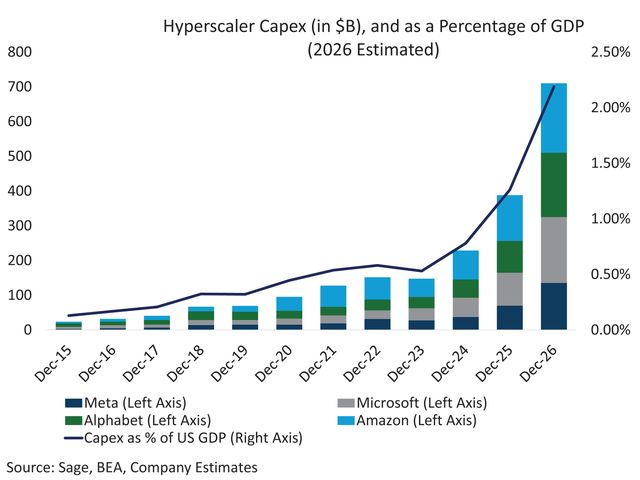
Here are the big four (excluding Oracle) who are on track for at least $720B of capex spend in 2026, an 80% increase over last year.
The modeling of the funding sources for the $5.5T in needed capital for the buildout is interesting and important. It breaks down as follows:
Organic Cash flow: $1.0T
IG bond issuance: $2.1T
Equity issuance: $0.8T
Alternative capital: $1.6T
In terms of cash conversion, hyperscaler capex has moved from approximately 33% of operating cash flow in 2023 to an estimated 93% in 2026, basically consuming all of the internally generated cash.
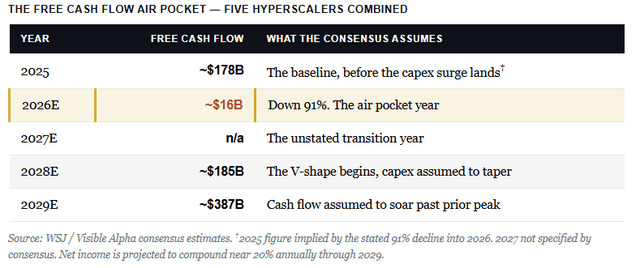
Realinvestmentadvice.com had this chart of free cash flow and noted:
That table is the entire bull case in five rows. The market isn’t paying for the $16 billion. It’s paying for the snapback to $387 billion. And the snapback is an assumption, not a result.
The bear case, in my opinion, is weak given that the proof of concept has already been established. We are already seeing the monetization of these investments. OpenAI and Anthropic alone are seeing truly incredible ARR increases in the last year and are projected to see that continue.
The AI ‘savings’ among companies deploying it into their businesses has also not been established and could be significant helping to create a crescendo of EPS growth over the next few years. That’s the hopium case anyway.
I highlight the recent comments by Amazon CEO Andy Jassey:
At this level of spend and higher, we have clear line-of-sight to strong financial returns. I’ll explain why. There are two major parts of the investment, the data centers and the servers and networking equipment that go into them. These have different capital cycles. Data center capital is spent starting two years before we can put servers into them to start monetizing. Once a data center opens with servers plugged in, we start generating significant revenue right away and then get to monetize these data centers for 30-plus years without having to spend that start-up capital again. Servers and networking equipment operate on a shorter cycle. We typically purchase these a few months before putting them into service, so we have strong visibility into customer demand before we trigger the spend. If the demand isn’t there, we won’t spend the capital.
And then there’s the META CEO Mark Zuckerberg:
..we’re getting a lot of offers for compute at a significant premium over what we paid for it...the high-level observation is that there’s just nowhere near enough compute for all the demand. That is why we see that basically, we are getting a large number of offers for the compute that we have.
This is the key chart:
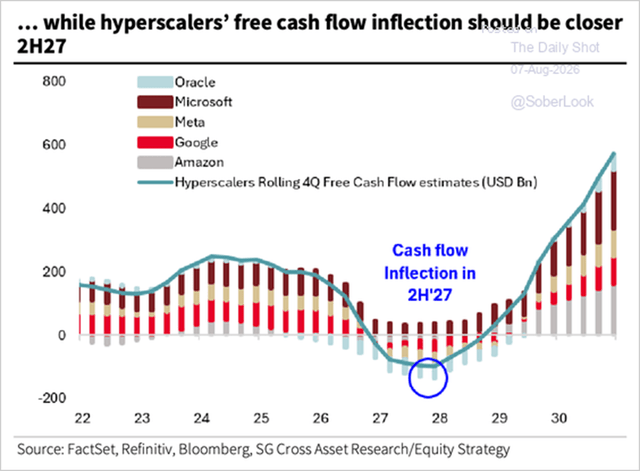
Investors and the media are focusing on the dip and fact that free cash flow goes negative, and ignoring the massive inflection after.
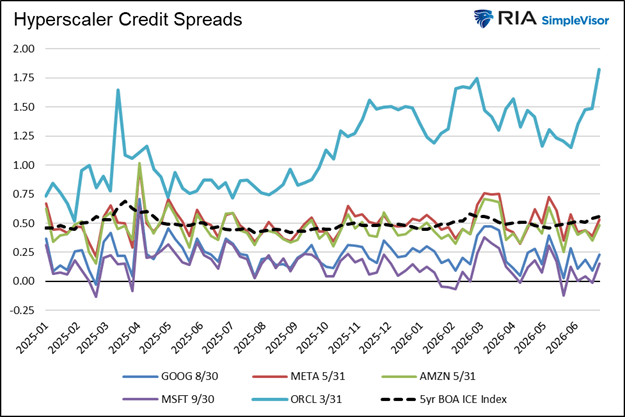
The media is highly focused on credit default swaps of these “blowing out” and widening because the market sees an increased chance of default. Garbage.
The proper way to analyze the bond markets assertion of the creditworthiness of the debt of these companies is credit spreads. But credit spreads have barely budged on all except Oracle. And even in Oracle’s case, it is still “ok”.
Another way to be a proper credit analyst is looking at interest coverage and leverage metrics, not CDS. RIA did the work for me. Oracle’s spreads have widened out but the other four have not even flinched. And Oracle’s widening of 100 bps is tame in the credit world. During Covid, spreads blew out by 1000-1200 bps, so 100 is not indicative of a bankruptcy warning.
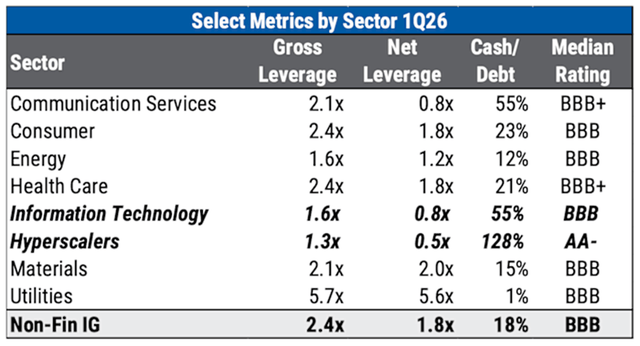
Here is net leverage numbers (total debt minus cash on hand). Even with all this debt issuance, the hyperscalers are barely levered. They are still well below the rest of the S&P sectors. And yes, they have off-balance sheet obligations that are large, but those are held in SPVs or joint ventures. They are lease commitments and GPU supply contracts.
But these are not unknown by the market. Nor are they a *new* phenomenon for these players. The market metrics including the credit spreads mentioned above, INCOROPORATE that information. Again, the credit spreads have barely budged.
Summing it all up
